
Factors of 48
Factors of 48 are all the numbers that are divisible into 48 without any remainders. These factors are whole numbers and can be both positive and negative. In this page, we will learn how to find out all the factors of 48, including prime factors of 48.
The answer of :
- Factors of 48 are : 1, 2, 3, 4, 6, 8, 12, 16, 24, 48
- Prime Factors of 48 : 48 = 2 × 2 × 2 × 2 × 3
Factorization Made Easy: Mastering the Art of
Factoring Numbers
Want to unlock the secrets of factorization? Our comprehensive guide equips you with the skills to effortlessly
factor
numbers like a pro.
Whether you're a student tackling algebra or an enthusiast seeking to deepen your mathematical knowledge, our
step-by-step approach demystifies factorization. From prime factors to factoring polynomials, we cover it all.
With our expert tips and
strategies, you'll confidently break down numbers into their prime components, revealing their fundamental
building blocks. Say goodbye to the
complexities of factoring and embrace the power of this essential mathematical tool. Start mastering factorization
and elevate your mathematical
prowess today!
Table of Contents :
Pair Factors of 48
In order to get the pair factors, we need to find two numbers multiplied together can get 48.
Multiplication
1 x 48
2 x 24
3 x 16
4 x 12
6 x 8
Positive pair
factors of 48
(1, 48)
(2, 24)
(3, 16)
(4, 12)
(6, 8)
Negative pair
factors of 48
(-1, -48)
(-2, -24)
(-3, -16)
(-4, -12)
(-6, -8)
Prime Factors of 48
To obtin the prime factors of 48, you need to find the factors of 48 and divide them out.
- 48 divided by 2 is 24
- Then if you keep dividing 24
- You get the final breakdown of the 48 = 2 × 2 × 2 × 2 × 3
Alternately, we can organize all the prime factors of 48 using a tree diagram:
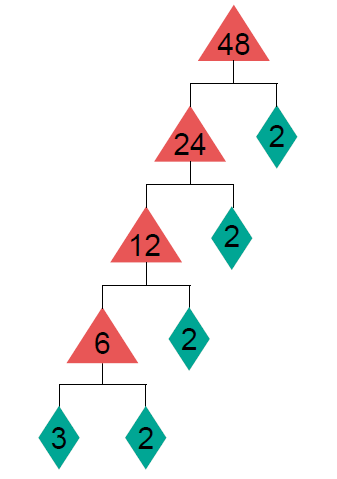
To list out all the prime factors : 48 = 2 × 2 × 2 × 2 × 3
To find out more factors:
How to Calculate the Factors of 48
Factors must be the whole numbers, which means fractions like 5.6 is not considered as a factor. We use the integers to divide 48, if there is no remainder, then the integers you use are the factors of 48. We can always dividing 48 by 1 to get started, then move to different integers.
48/1 = 48 (Factor = 1 and remainder = 0)
48/2 = 24 (Factor = 2 and remainder = 0)
48/3 = 18 (Factor = 3 and remainder = 0)
48/4 = 12 (Factor = 4 and remainder = 0)
48/6 = 8 (Factor = 6 and remainder = 0)
Note:
If we divide 56 by numbers other than 1, 2, 4, 7, 8, 14, 28 and 56, there must be a remainder. Let us try 3,
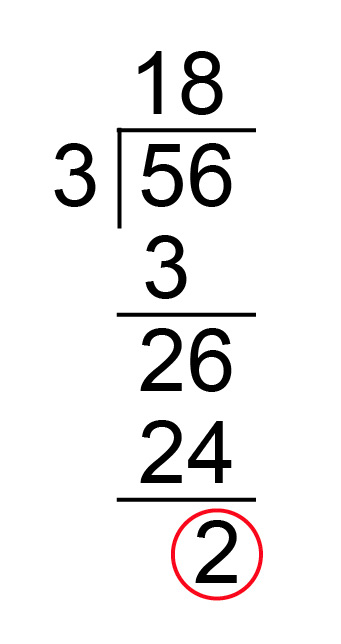
2 is the remainder, then 3 is not the factors of 56
Examples
1. Find the common factors of 23 and 56
Answer:
The factors of 23 are: 1,23. (23 is a prime number)
The factors of 56 are 1, 2, 4, 7, 8, 14, 28 and 56
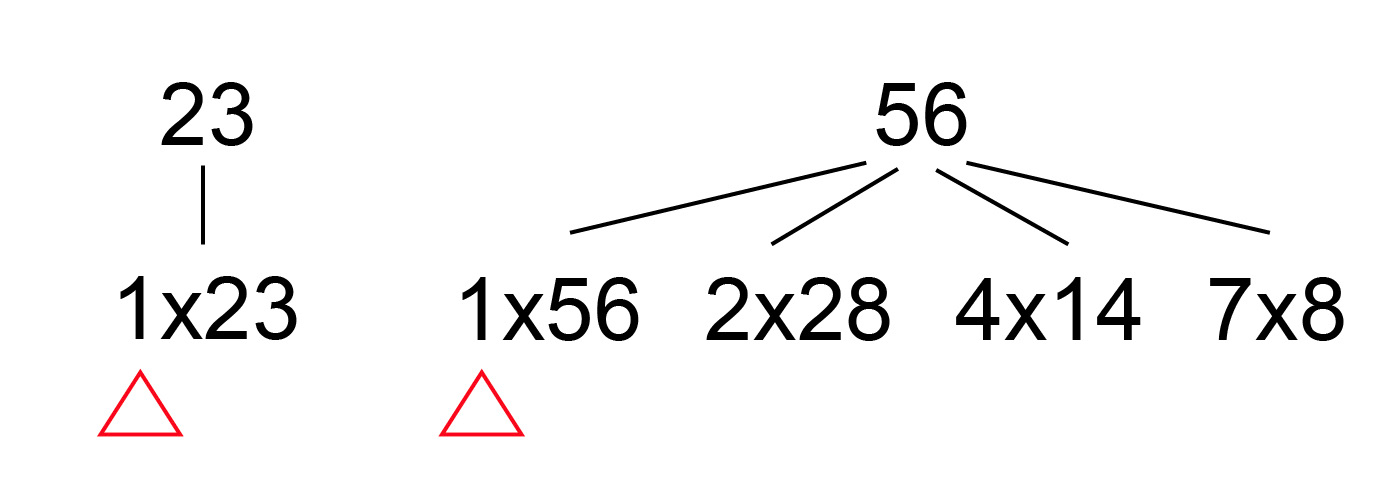
Thus, common factor of 23 and 56 is 1.
2. Find the common factors of 52 and 56
Answer:
The factors of 52 are: 1, 2, 4, 13, 26, and 52.
The factors of 56 are 1, 2, 4, 7, 8, 14, 28 and 56
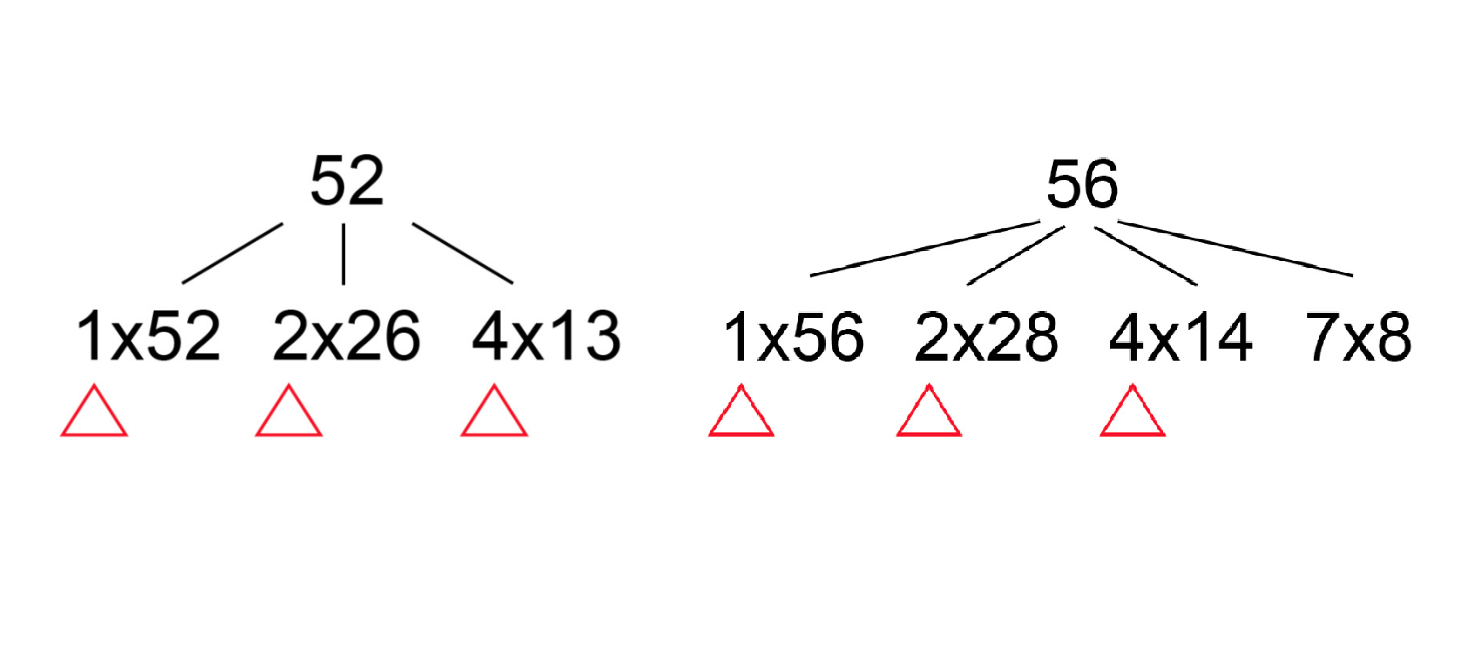
Thus, common factosr of 52 and 56 are: 1, 2, 4
3. Find the common factors of 33 and 56
Answer:
The factors of 33 are: 1, 3, 11 and 33.
The factors of 56 are 1, 2, 4, 7, 8, 14, 28 and 56
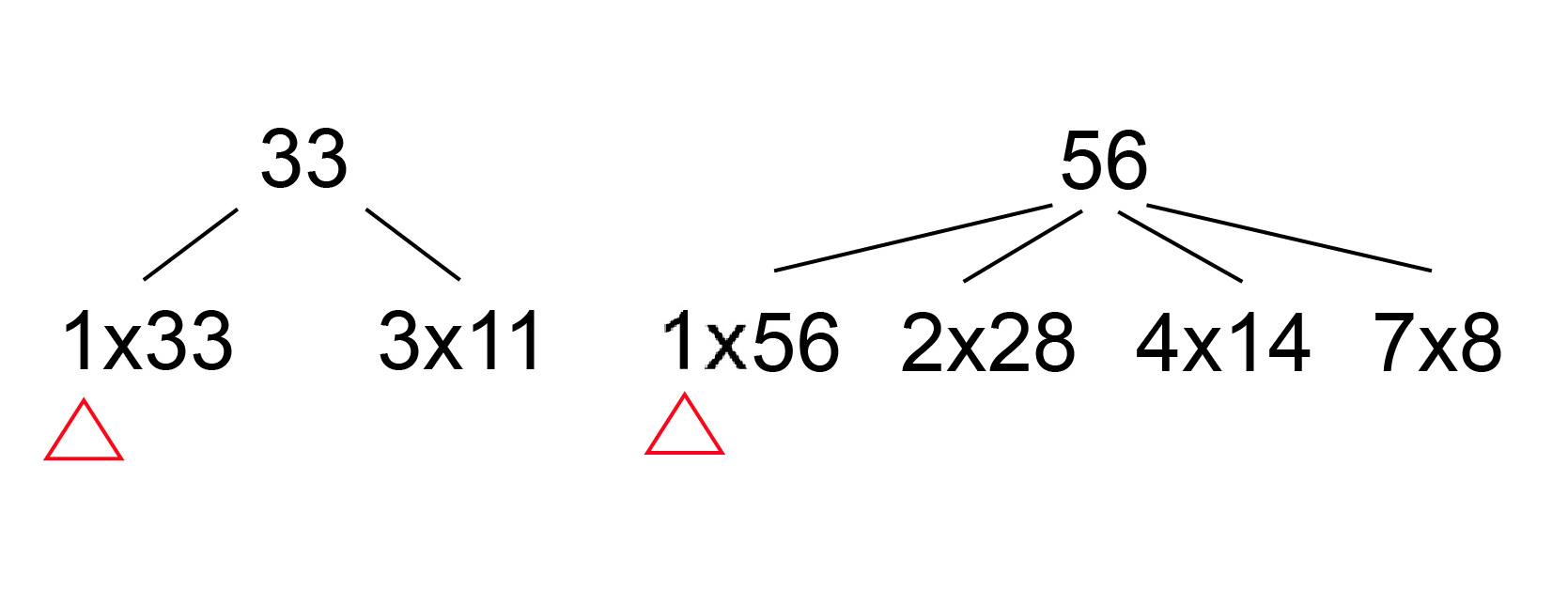
Thus, common factor of 23 and 56 is 1.
FAQ - Factor of 56
What are the multiples of 56?
1x56=52, 2x56=112, 3x56=168, 4x56=224, 5x56=280...
Is 56 prime or composite?
Composite number, because 56 can be divided evenly by 1 and 56, (2, 28), (4, 14), (7, 8) are also the pairs of factors of 56
How many prime factors are there in 56?
The prime factors of 56 = 2x2x2x7, which means there are 2 prime factors in 56, they are 2 and 7.
What is the perfect number?
The perfect number is a positive integar that equal to the sum of its proper divisors.( not include itself) For example, 6 is the smallest perfect number, the factors of 6 are: 1,2,3,6. 6=1+2+3
Do numbers end?
No, numbers are infinite and never end.